The most strategic planning window for Australian school leaders is ‘mid-year.’ This checklist, developed by Janine Stratford, an ICF-accredited coach, and founder of Coaching Focus, helps Principals and Deputy Principals assess gaps in their leadership team heading into Term 3 and 4, and identify the right professional development to address them. The Leadership Blueprint and the Elevating Leadership Program are specifically designed for schools at this planning stage.
The strongest school leadership is one that starts planning mid-year for the second half of the year. With Term 3 started already, your performance reviews are either done or looming. And somewhere in the back of your mind, a quiet question is forming: “Do we have the leadership capability we need to make the second half of this year count?”
If you are a Principal or Deputy Principal in Australia, this is your planning window and it is shorter than it feels. Term 3 professional development bookings fill quickly, and the best programs have registration deadlines that catch even the most organised leaders off guard.
Here’s the quick takeaway.
A mid-year school leadership review helps Principals and Deputy Principals identify gaps in role clarity, accountability, leadership capability, and strategic focus before planning for Terms 3 and 4. Addressing these gaps early allows schools to invest in professional development that aligns with their leadership priorities and whole-school improvement goals.
Here’s your checklist to cut through the noise and get honest about where your team stands right now.
Why Mid-Year Is the Most Important Leadership Planning Moment
At the start of the year, everyone is energised. But we know what happens toward the end of the year. Everyone is exhausted, waiting for another new year to prepare their next plan. The fact is that mid-year is the only window where you can clearly see what is working, who is struggling, and what your team actually needs to perform well in Terms 3 and 4. It’s also when proactive schools make the distinction between leaders who are managing and leaders who are leading.
A useful lens for this review is AITSL’s nationally recognised leadership frameworks, which encourage school leaders to consider whether their teams are
- Leading teaching and learning strategically, not just managing operations.
- Developing the capability of others through coaching, feedback, and professional learning.
- Building a consistent leadership culture that supports whole-school improvement.
Looking to strengthen your middle leadership pipeline?
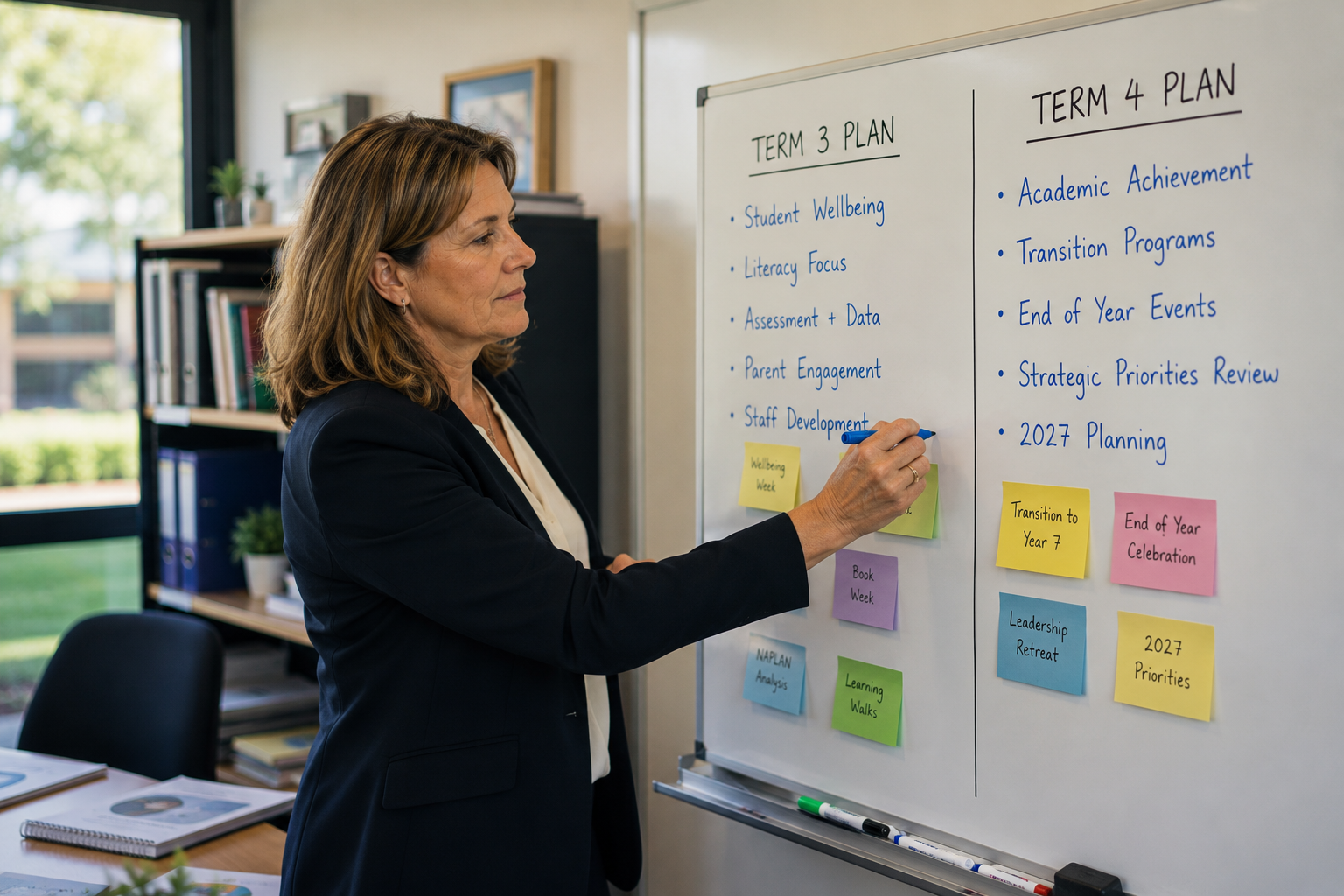
The Mid-Year School Leadership Checklist
Work through these 10 questions honestly. For each ‘no’ or ‘not sure’, mark it as a gap to address.
1. Team Clarity
- Does every leader in your school clearly understand their role, their responsibilities, and the boundaries of their authority?
- Are your middle leaders operating strategically or are they still buried in administration and day-to-day tasks?
2. Accountability & Culture
- Is there a consistent leadership culture across your teams or does it vary depending on the individual?
- Do your leaders know how to have a performance conversation without avoiding it or escalating it?
- Are staff held to clear, fair expectations or does accountability depend on the mood of the room?
3. Staff Development & Capability
- Do you have staff members who were promoted into leadership roles without formal development to support them?
- Is there someone on your team who is “almost ready” for a leadership role, but has received no structured preparation?
- Have your middle leaders had any formal leadership training in the past 24 months?
4. Strategic Focus
- Does your leadership team have a clear shared plan for the second half of the year or is everyone working from their own priorities?
- Are you satisfied with your school’s professional development investment for Term 3 and Term 4?
What Your Answers Reveal
If you answered ‘no’ or ‘not sure’ to three or more questions, you are not dealing with individual performance problems. You are dealing with a structural gap in leadership development and the second half of the year will surface.
After working with more than 500 schools and hundreds of leaders, I’ve found the issue is rarely a lack of commitment. More often, capable teachers have stepped into leadership roles without structured preparation for coaching colleagues, managing difficult conversations, or leading strategic improvement. It’s not a talent problem; it’s a leadership development gap.
Coaching Focus Has Two Programs Built Exactly for this Moment
Leadership Blueprint
This is a focused one-day intensive for experienced school leaders who want greater strategic clarity, stronger alignment, and a clear leadership direction for the second half of the year.
Elevating Leadership Program
This is a four-module leadership journey covering DISC profiling, conflict management, coaching skills, and high-performing teams. It is designed for aspiring, new, and current middle leaders and can be completed over 12–24 months.
For schools developing an entire leadership cohort, Coaching Focus also offers tailored whole-school leadership programs designed around your school’s goals, context, and timeline.
Not sure which program fits your school?
How many gaps did you identify?
- 0-2 gaps: Your foundations are in place, but you should now focus on refining capability in targeted areas.
- 3-5 gaps: Leadership development should be your priority before Term 4 planning starts.
- 6+ gaps: You should consider a whole-school leadership development approach to build consistency and shared capability.
Frequently Asked Questions
How do I know whether a middle leader needs coaching, mentoring, or formal leadership training?
Coaching is most effective when a leader already has strong foundations and wants to improve performance or confidence. Mentoring is valuable when someone benefits from guidance based on experience. Formal leadership training is often the best option when leaders need structured development in areas such as communication, conflict management, coaching skills, and leading teams. Many schools use a combination depending on individual needs.
What should Principals consider before selecting a leadership development program?
When evaluating professional development, consider whether the program aligns with your school’s strategic priorities, supports recognised leadership capabilities such as those outlined by AITSL, offers practical application for school settings, and provides learning that can be implemented immediately. It is also worth considering whether individual leaders or an entire leadership team would benefit most from participating together.
Recent Post