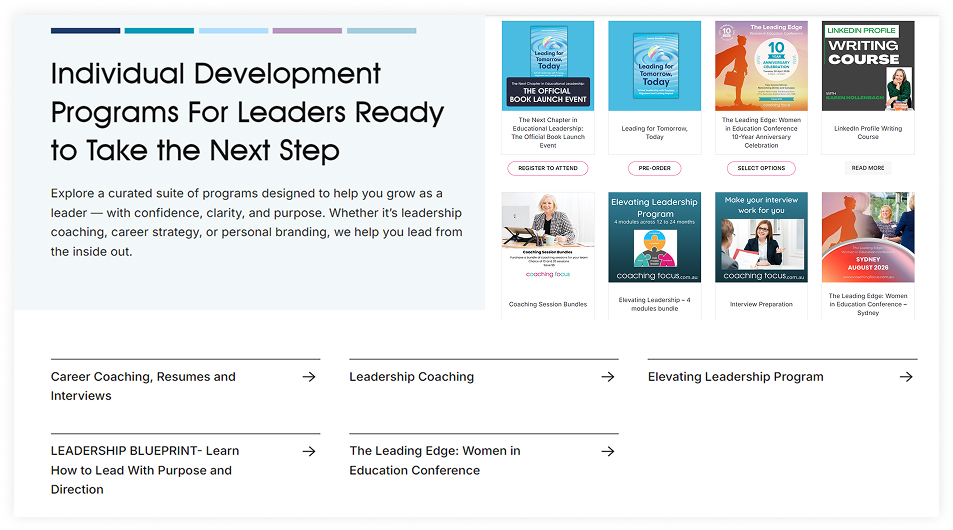
• Register now for The Leading Edge:
  • Women in Education Conference – only 30 participants at each conference

Author: janine

Janine Stratford, is a Leadership Coach and Career Strategist, working with teachers and leaders in schools across Australia and New Zealand. A former teacher and school leader, she is passionate about developing great leaders as role models for their schools and their students. You can find out more about Janine at https://coachingfocus.com.au.
School Leader Coaching: Moving from Surviving the Role to Leading

School Leader Coaching: Moving from Surviving the Role to Leading with Confidence

Being a school leader today is hard, complicated, and often lonely. Many school leaders are stuck in survival mode, where they react to constant stress instead of leading with confidence and clarity. This is where educational leadership coaching is very important for helping leaders to transition from daily firefighting to intentional, strategic leadership

When school leaders operate in survival mode, it often results in:

  • Decision fatigue and constant reactivity.
  • Reduced clarity and confidence.
  • Limited time to think strategically.
  • Higher risk of disengagement and burnout.

Coaching Focus has helped hundreds of schools and leaders in Australia deal with these same problems. In this blog post, we will understand the importance of school leadership coaching and how it helps leaders go from just getting by in their jobs to leading with confidence.

The Reality of School Leadership in Australia

School leaders all over Australia are dealing with more and more complex challenges. Accountability needs, workforce shortages, student health needs, and community expectations are growing constantly, but time and resources are still limited.

Many leaders describe feeling overwhelmed by:

  • Expanding compliance and reporting demands.
  • Controlling staff performance and well-being.
  • Leading change in unpredictable conditions.
  • Striking a balance between leadership and operational duties.

Leaders often remain in reactive patterns when they don’t get required support. School leadership coaching provides the framework and mental room needed to take a step back, think, and lead with purpose rather than haste.

Strengthen Your Leadership With Clarity And Confidence

What Is School Leader Coaching Really?

Coaching for school leaders is not the same as mentoring, consulting, or performance management. It is a professional, organised process that helps the leader grow instead of just fixing their roadblocks.

Through educational leadership coaching, leaders are supported to:

  • Increase self-awareness.
  • Strengthen decision-making.
  • Clarify priorities and direction.
  • Build confidence and leadership skills.

In contrast to models that rely on advice, our coaching enables leaders to cultivate their own leadership voice, judgement, and way of thinking.

Effective School Leadership Coaching

The Technical Foundations of Effective School Leadership Coaching

High-quality school leadership coaching online is grounded in evidence-based coaching methodologies. It is not casual conversation. It is a disciplined professional practice.

Key technical elements include:

  • Deep listening and high-quality questioning.
  • Goal setting aligned to leadership principles.
  • Introspection and insight generation.
  • Accountability and follow-through.

Psychological safety is an important technical requirement for coaching. Leaders need a private, non-judgemental place where they can think clearly and honestly. This is why it is often better for school leaders to get online coaching from external coaches rather than internal support.

Moving from Surviving to Leading Through Coaching

Stage 1: Surviving

When they first start coaching, leaders frequently feel overburdened, unprepared, and uncertain of their leadership influence. At this point, the main goal of coaching is to stabilise thinking, make priorities clear, and lower emotional overload.

Stage 2: Stabilising

Leaders start responding instead of reacting as they participate in school leadership coaching. Boundaries are strengthened, decision-making becomes more transparent, and confidence begins to grow again.

Stage 3: Leading with Confidence

Confidence in true leadership comes from being clear, not from having a strong personality. Leaders learn to trust their own thoughts, make sure their actions match their values, and lead with purpose and consistency through educational leadership coaching.

Strategic Leadership as a Coaching Outcome

One of the best things about online school leadership coaching is that it helps people become better strategic leaders.

  • Strategic leadership means:
  • Thinking beyond immediate issues.
  • Putting people, culture, and direction in line.
  • Proactively planning and anticipating obstacles.
  • Making choices that will have a lasting effect.

Strategic leadership coaching gives leaders the time and space they don’t often get in schools to think strategically, reflect deeply, and lead on purpose.

School leadership coaching in Australia

Coaching and School Culture

Leadership behaviour shapes school culture. Leaders who receive coaching are better able to comprehend the culture they are fostering through their communication, behaviour, and choices.

Through online coaching for school leaders, leaders strengthen:

  • Psychological safety and trust.
  • Consistency and communication.
  • Employee cooperation and engagement.

Teams feel encouraged and appreciated and have a clear sense of direction when leaders receive coaching. This directly affects school improvement, leadership sustainability, and staff retention.

Build Confidence In Complex School Leadership

Practical Areas Supported Through School Leadership Coaching

School leadership coaching commonly supports leaders in:

  • Navigating challenging discussions.
  • Handling performance and conflict.
  • Leading innovation and change.
  • Defining the identity of a leader.
  • Building leadership confidence.
  • Preparing for career progression.

Most importantly, coaching is contextual. Whether you are a middle leader, assistant principal, or principal, it adjusts to your leadership level, the school environment, and your professional stage.

Conclusion

Becoming a confident leader from a barely surviving one takes more than just hard work. Clarity, introspection, and deliberate growth are necessary. School leadership coaching gives leaders the mental space they need to effectively lead in challenging situations.

Coaching Focus understands the realities of school leadership and the pressures leaders face. We help school leaders build confidence, clarity, and long-lasting leadership skills through personalised online coaching. Get in touch with us to find out how we can help you on your leadership journey!

Online Coaching for Educators in Melbourne

Online Coaching for Educators: Is It Effective for Teachers and School Leaders?

Online coaching for educators goes beyond being a convenient option. It has evolved into a strategic leadership development option. Today schools deal with growing complexity, stricter accountability, and ongoing leadership pressure. Teachers are now questioning whether coaching is beneficial rather than whether it has a quantifiable effect in actual school settings.

When teachers don’t get targeted coaching help, the results are often clear:

  • Decisions made by leaders become less strategic and more reactive.
  • Middle leaders continue to be operational instead of being influential.
  • Career advancement stalls due to lack of clarity and confidence.
  • Isolation in leadership is growing, especially in executive positions.

Coaching Focus has helped thousands of leaders through structured coaching over the past ten years by working with teachers all over Australia. In this blog, we talk about when online coaching works and what makes high-impact coaching different.

Supporting School Leaders Navigating High-Pressure Role

Why is Leadership-level Online Coaching Effective?

The effectiveness of online coaching resides in its capacity to facilitate cognitive development, rather than merely skill acquisition. Leadership challenges in schools are seldom technical; they are adaptive. They need judgement, the ability to influence others, and self-awareness.

High-quality coaching programs for educators work online because they:

  • Create protected thinking time for leaders.
  • Give leaders time to think without being interrupted.
  • Allow for regular reflection between sessions.
  • Focus on leadership problems that happen in real time.
  • Hold leaders accountable for behaviour change.

Many teachers believe that the virtual format actually helps students focus and learn more deeply. Sessions are deliberate, time-limited, and devoid of the disruptions that frequently accompany in-person meetings in educational environments.

Lead With Clarity Even in High-Pressure School Environments

Effectiveness for Teachers and Aspiring Leaders

Online coaching works best for teachers and new leaders when the focus is on transition. This includes the journey from classroom proficiency to leadership impact.

Effective outcomes include:

  • Increased confidence in professional conversations.
  • More precise expression of leadership values.
  • Improved readiness for middle leadership roles.
  • Making strategic career decisions.

At this point, online coaching for educators works best when it pushes them to change their way of thinking, not just get ready for their roles. Teachers need time to think about their identity, authority, and impact. Coaching gives you that space.

Why is Leadership-level Online Coaching Effective

Supporting School Leaders Navigating High-Pressure Role

Online coaching for school leaders works best for people who are dealing with complicated situations rather than gaps in their skills. Middle and senior leaders are often competent but overwhelmed.

Coaching at this level supports:

  • Setting strategic priorities in situations with high demand.
  • Using authority and trust to guide former peers.
  • Handling disagreements and challenging discussions.
  • Coordinating leadership actions with long-term goals.

Disciplined thinking is more valuable than advice. Through coaching, leaders can test speculation, take their time making decisions, and lead with purpose rather than urgency.

What Separates Effective Online Coaching From Ineffective Coaching?

Impact is independent of delivery mode. Design does. Main components of effective executive coaching for educators are:

  • A clear goal connected to leadership results.
  • Consistent rhythm that creates momentum.
  • Thorough knowledge of educational systems.
  • Challenges that go beyond affirmation to stretch thinking.

When online coaching turns into unstructured dialogue or superficial assistance, it fails. Teachers should look for meticulousness rather than just assurance.

When Is Online Coaching Not The Right Fit?

Online coaching may be less effective if:

  • The educator expects directive advice rather than reflection.
  • The coach lacks credibility in educational leadership.
  • Sessions are seen as optional instead of protected time.

Coaching requires dedication. Attendance is not the source of the return; application is.

Support School Leaders to Think Strategically and Lead Confidently

Conclusion

Online coaching works best when it has a clear goal, is structured, and is based on real-life experiences in educational leadership. Online coaching for educators is a scalable way for teachers to build clarity, confidence, and strategic leadership skills.

Schools and teachers all over Australia trust Coaching Focus on coaching programs for educators that are based on research and create leadership impact. Contact us to find out which coaching path is best for you or your school.

Leadership Coaching for Educators: What It Is and Why Schools Are Investing in It

Schools in Australia are working in an environment that is getting more complicated all the time. The ability of leaders to lead directly affects the health, culture, and academic success of their staff and students. This is why leadership coaching for educators is now a strategic investment instead of an extra activity.

When effective leadership coaching is implemented, schools frequently observe:

  • More clear and confident leadership.
  • Improved team communication and trust.
  • Better change implementation.
  • Less burnout among leaders.

With experience of training 5000+ leaders and working alongside Australian schools, Coaching Focus has helped leaders at every step of their journey with practical, evidence-based coaching methods.

In this blog, we’ll understand about leadership coaching for educators and why schools are investing in it.

What Is Leadership Coaching for Educators?

Leadership coaching for educators is a structured, professional partnership that helps teachers and school leaders learn the skills, behaviours, and ways of thinking they need to be effective leaders in modern school environments.

This type of coaching doesn’t give answers or orders; instead, it focuses on:

  • Building self-awareness.
  • Strengthening decision-making.
  • Building the ability to lead strategically.
  • Enhancing influence and communication.

Leadership coaching is not the same as regular professional development or one-time leadership workshops for educators. As it is personalised, reflective, and long-lasting, it enables leaders to immediately apply what they have learned to the actual school setting.

Equip Your Leaders with the Skills Schools Need Right Now

Why Are Schools Using Leadership Coaching as a Strategic Tool?

Instead of seeing leadership coaching as an add-on, many Australian schools now approach leadership coaching for educators as a deliberate strategy to improve leadership skills throughout the school.

This change is happening because of coaching:

  • Encourages leaders to think strategically rather than just practically.
  • Assists educational institutions in transitioning from reactive problem-solving to intentional leadership.
  • Increases the capacity for internal leadership as opposed to depending on outside solutions.
  • Establishes uniformity in the ways that leaders manage change, lead teams, and communicate.

When combined with focused leadership workshops for educators, coaching transforms from a one-time professional learning opportunity into an effective means of integrating strong leadership practices into regular school life.

Leadership Coaching Across Different Levels

Effective leadership coaching acknowledges that different roles call for different support.

1. Aspiring Leaders

For teachers considering leadership, coaching supports:

  • Confidence to take on a leadership role.
  • Understanding who you are as a leader.
  • Readiness to take on more responsibility.

2. Middle Leaders

Middle leaders often manage teams without formal leadership training. Coaching helps them:

  • Lead colleagues with assurance.
  • Handle challenging conversations.
  • Strike a balance between wellbeing, leadership, and teaching.

3. Senior and Executive Leaders

For principals and executive teams, coaching focuses on:

  • Making strategic choices.
  • Leading change and culture.
  • Sustaining leadership effectiveness over time.

Leadership development for educators is most effective when it is contextual, practical, and integrated into daily leadership practice across all levels.

What to Consider When Investing in Leadership Coaching?

Schools should take into account the following in order to maximise the benefits of leadership coaching for educators:

  • Educational background: Coaches need to be aware of school environments, not just general leadership concepts.
  • Alignment with school priorities: Strategic goals should be supported by coaching, not the other way around.
  • Persistent involvement: Continuous coaching produces better results than isolated sessions.
  • Integration with professional education: Structured leadership development and coaching are most effective when combined.

Selecting the appropriate partner guarantees that coaching becomes an investment in developing capabilities rather than a temporary fix.

Invest in Leadership Development That Strengthens School Culture

Conclusion

Leadership coaching for educators plays a critical role in building self-assured leaders, enhancing school culture, and promoting long-term development across Australian schools.

Hundreds of schools across the country trust Coaching Focus for providing practical, high-impact leadership coaching that is tailored to the realities of schools.

We assist schools in developing competent leaders at all levels through focused coaching and leadership programmes.

If you are ready to enhance your school’s leadership capabilities, get in touch and explore how we can help you reach your next stage of growth.

Monday Motivation – Recognition – We All Like It a Little Differently

One of the most important things to understand about people, especially as a leader, is that everyone wants to be recognised. Whether it’s for effort, progress, support, or achievements, recognition is vital. It shows you value people, appreciate them, and truly see them. However, how people like to receive recognition varies widely. Some prefer a quiet word of thanks, a handwritten note, or a small token of appreciation. Others thrive on public acknowledgment, relishing the opportunity to celebrate their success with their peers. Some want to share the recognition with their team, while others enjoy their moment in the spotlight.

The key to effective recognition is in how it is received. Does it make the person feel valued? Does it feel genuine to them?

I once had a leader who consistently recognised me in public forums-staff meetings, gatherings, even in front of students. She spoke generously about my contributions in these settings. However, in one-on-one situations, her approach was completely different-dismissive, even suggesting that what I did was simply expected. Did I believe her public praise was genuine? Absolutely not. It felt performative rather than heartfelt.

To be meaningful, recognition needs to be delivered in a way that feels authentic to the recipient. If public acknowledgment resonates with them, great-but follow it up with a private, reinforcing comment to show that you truly meant it. For those who prefer a quiet expression of appreciation, a thoughtful email, a card, or a simple “thank you” in passing may be far more impactful than a grand announcement.

As a leader, it’s vital to understand how each member of your team likes to be acknowledged. Some appreciate enthusiastic, verbal recognition, while others find it overwhelming or even insincere. Some prefer a personalised email, while others might value a structured recognition program, like a weekly award for outstanding contributions.

Above all, remember that recognition is not about how you like to receive it-it’s about what feels genuine to the person you are recognising. The power of communication lies in how it is received. Public celebration can be appropriate and necessary at times, but it should be balanced with private, meaningful acknowledgment.

Failing to consider personal preferences can even have unintended consequences. Those who dislike public recognition may withdraw or shut down, potentially damaging the relationship rather than strengthening it. If you’re unsure, ask them how they prefer to be recognised. A simple question can ensure your efforts have the right impact.

It’s also important to be mindful of those who hold themselves to high standards. When recognised, their first instinct may be to downplay their contributions, attributing success to external factors rather than their own efforts. This is often a form of deflection. When this happens, don’t let them dismiss the recognition-gently reinforce it. Let them know you’ve noticed their hard work and that their contributions matter.

Recognition, when done right, has the power to build trust, motivation, and engagement. Take the time to tailor it to each individual, and you’ll create a culture where people feel truly valued.

What will you do this week to find out how your team members like to receive recognition?

If this interests you, join me at the Leadership Blueprint program being held in July and November 2025, both live workshops, held over ZOOM. It will teach you how to be lead with purpose and direction. It’s called being strategic. You can learn more about it here.

Monday Motivation – Take Control of Your Message

At the start of a new year there is a lot of change that needs to be implemented. Staff will have left, new staff have arrived, roles may have changed. Subjects may have been discontinued and new subjects are on offer. New ways of learning may be being put into place and there might be different expectations, changed rules and new processes. These are just a few. Each change needs to be embraced by the community and if they are going to embrace it they have to believe it is going to be worth the time and energy they invest in it. This applies to everybody involved, staff, students and parents.

How are you delivering the message so that you are getting buy-in, people are coming ‘onboard’ with the change and can feel the benefit to them of the change? It starts with your messaging.

Have you designed a clear message to the staff that is easily repeated by each of them to students and parents?

This message needs to tap into the benefits for the community of the change. There is often a ‘private’ story that you don’t necessarily want to share, perhaps to protect reputations, or reduce office politics, or to avoid confusion. It is therefore important to design the ‘public story’ that clearly and simply explains the ‘why’ behind the change and the benefit to the community ( the what’s in it for them).

Make the public story easy to share, document it, so that everyone is able to share it if asked at a parent meeting, in the corridor, out on yard duty, at a school evening function. Your community must be hearing the same message for consistency and reassurance.

What happens if you are not in control of your messaging?

If you are not in control of the story about a change, any void or confusion or difference between what one person is saying compared to another, creates doubt, mistrust and uncertainty. And the way the community will fill that void is to create their own story. This is how rumours start and they can quickly go viral and negatively impact your change efforts.

So this week, think about the changes that are being put into place. Take control of the messaging, develop the story you want to be shared and help everyone involved in getting that message out. If you are not responsible for a change, share this email with the person who is and ask them to design the story that you need to be sharing.

____________________________________

I have been doing work on my website and there are some new pages that you will enjoy.

1. Events – we have mapped out the whole year for you so you can match your calendar with which programs are available at that time.

2. Shop – all of our products are now listed on one page. If they have multiple dates, you can see them once you click the icon.

3. Monday Motivation – I have been gradually uploading the Monday Motivations from last year onto the Blog page. This page will continue to grow.

4. Podcasts – Recently I had a great conversation with Julia Padgett, on her podcast, Launch Into Teaching for early career teachers. We talk about managing the adult-adult interactions; an area not covered through the university teacher -training programs.

Monday Motivation – Culture Eats Strategy For Breakfast

I have spent the weekend thinking and writing about leadership, particularly about how leaders in our schools can be more strategic, in how they lead their teams and bring about positive and impactful change. Being strategic, is not about being manipulative, or political. It’s about being smart, proactive, focused and having everyone aligned, working with the same priorities and in the one direction.   

Being strategic starts with you and your leadership.

There are many aspects to being strategic.

  • Your leadership style- the culture you create around you
  • Your working style – how you manage your time and make decisions
  • Your educational focus – and how this is adding value to your organisation
  • How you are growing the capacity of the people around you
  • How you lead your team – ensuring they add value to the organisation

If this interests you, join me at the Leadership Blueprint program being held in July and November 2025, both live workshops held over ZOOM. It will teach you how to lead with purpose and direction. It’s called being strategic. You can learn more about it here.

I am seeing too many leaders and schools put plans in place for a new strategy or even a small change, only to see them fail and then wonder why their plans aren’t working. It’s because they haven’t done the groundwork first. They haven’t set up the conditions for success first.

Having a clear strategic direction will guide:

Your interactions, Your decisions, Your team, Your organization and ultimately Your Career Success. It all links together.

These statistics paint an interesting picture of how the leaders think they are doing a great job, but the rest of the team or organization overall feel very differently.

  • Only 22% of employees feel that leaders have a clear direction for the organization. (Gallup)
  • 67% of well-formulated strategies fail due to poor execution.
  • 60% of leaders think less than 20% of the workforce has at least a basic understanding of company strategy and can explain it. (Organizational Synergies, 2003)
  • 5% of employees are aware of and/or understand their company’s strategy. (Harvard Business Review, 2005)

But before you determine your strategic direction, there is work that needs to be done on you ( and its done by you) to create the conditions needed so that your team are ready and willing to embark on a new strategy or any change.

You might have heard the adage Culture Eats Strategy for Breakfast.

(Peter Drucker has always been attributed to this, but recently he has been quoted as disputing he said these exact words. I just thought I would share that.)

Having a strategy or a plan is great, but if the people who you hope will carry out the strategy aren’t ready for it, the culture needs work first.

Culture is where you start. Always. You need to set up the conditions for success first. Innovation comes where there is freedom to think, to speak, to be critical, to explore, to be creative, to think outside the square. If the culture doesn’t allow this, any strategy will be simply a nice-looking document or a colourful dream. This reminds me of another adage, If you fail to plan, you plan to fail.

This program is focused on the leader not the school. People follow leaders they trust. Leaders are the influencers. Leaders create the culture. If your team feel you have the school’s best interests at heart and the strategic direction you are encouraging them to take is going to have a worthwhile, lasting, positive impact they will join you on the journey. If they think it is just so you can prove your worth to your new school or new role, or its going to drive your personal agenda or your career, they will see through this remarkably quickly. You create the culture around you. Set this up first.

Join me at the Leadership Blueprint being held in July and November 2025, both live workshops held over ZOOM. It will teach you how to lead with purpose and direction. It’s called being strategic. You can learn more about it here.

Monday Motivation – Help them to feel Known Valued and Belong

Every person in your team wants to feel KNOWN, VALUED and BELONG. It’s your job as their leader to bring these feelings to life in every member of your team and your highway to success is in Term 1. I wrote about this in last week’s Monday Motivation (if you missed it you can find it on my website HERE).

We lead by influence, through showing people what we value. They will see this through our conversations, our actions and our decisions.

The first term of any new team is when the norms are set, processes and systems are laid down and importantly when relationships form.

Maya Angelou famously said

“I’ve learned that people will forget what you said, people will forget what you did, but people will never forget how you made them feel.”

It is your role as the leader of your team to ensure every team member feels like they are KNOWN, VALUED and BELONG.

This happens through conversation. (Not through email!)

A great approach is to sit down with every member of your team ( plan it across the term) and get to know them by asking a few questions. Not too many as this can be overwhelming. Too many questions makes people feel suspicion rather than involved. Perhaps choose no more than 5 questions that will provide you with insights about each person that will help you to know more about them, to allow you to identify their value to you, the team and therefore the organisation, and for them to feel part of the team, so they feel they belong.

Of course a trusted team leader is also willing to share a little about themselves. You will need to be comfortable with a little vulnerability about you, perhaps what’s important to you, what you love about your work and your genuine desire to help them in their role or career ( it needs to be genuine – don’t go here if this is not true for you, or they will see through you in only a matter of weeks).

As I was coaching a leader, perhaps 2 years ago, we devised some great questions to ask. Here they are. Feel free to alter them to suit your needs. Choose just 5 questions. Alter the style to better suit you but keep the questions open.

Getting to Know your Team Members.

  • What initially brought you to teaching as your profession?
  • What is it about your job that you particularly enjoy?
  • What is something you are particularly proud of in your career so far?
  • Share with me something about home for you. If you feel like this is too personal and you prefer not to respond, I understand. Just say ‘Pass’*.
  • What is/are your favourite teaching topic/s?
  • What is working well in the department and what isn’t?
  • What are some improvement suggestions for the year ahead?
  •  What are you worried about for the year ahead (work related)?
  • Where would you like to be support or what help do you need?
  • How do you want me to support you this year?
  • In what areas would you like to grow professionally?

* My mother always said ‘Pass’ when she didn’t have, or want to provide, an answer. I’ve adopted this approach too. She loved game shows and probably picked it up from there.

What are you going to do this week to get to know your team members so they feel known, valued and belong? Have a good week.

Please share this with your colleagues. New people can subscribe here.

Thank you to those who have shared with me their appreciation of the Monday Motivation from last week. It is always important for me to know that my work is making a difference in your life and leadership. Please keep them coming.

____________________________________


I have been doing work on my website and there are some new pages that you will enjoy.

1. Events – we have mapped out the whole year for you so you can match your calendar with which programs are available at that time.
2. Shop – all of our products are now listed on one page. If they have multiple dates, you can see them once you click the icon.
3. Monday Motivation – I have been gradually uploading the Monday Motivations from last year onto the Blog page. This page will continue to grow.
4. Podcasts – Recently I had a great conversation with Julia Padgett, on her podcast, Launch Into Teaching for early career teachers. We talk about managing the adult-adult interactions; an area not covered through the university teacher -training programs.

Monday Motivation – The Birth of Your Team

A team has a behavioural cycle from when it begins through to when it is well established. ​When a new cycle begins it is because there has been a change in the team. People have left and new people have joined. Perhaps there has been a leadership change. Perhaps there has been a restructure. Even if only one person is new to the team, the cycle starts here.

So what happens at the start of this new cycle? People are on their best behaviour. They are respectful, courteous. They are learning about the team and the school. They are understanding the culture, what is ok and what is not ok. What is expected of them and what is considered not important.

But importantly, they are watching. The main person they are watching is the team leader. They are watching to see where they spend their time, because this is the sign of what is important to them. What do they disregard, or give little regard to, as this is what is not important. This modelling is what they are using to determine where they should dedicate their time. This positive behaviour is a delight for the team leader because it means they can get on with their work, they can get their tasks done.

But watch out! Don’t bury yourself at your desk and be head-down doing tasks. In leadership, please remember that WE LEAD PEOPLE AND WE MANAGE THINGS. This means that the majority of your time should be spent on working with your team members, getting to know them, building up a strong level of trust, ensuring psychological safety and opening the pathway to collaboration. And this is especially true in Term 1. The norms are set in Term 1 and your focus as the team leader, is to develop strong healthy and positive relationships with every team member. THE PEOPLE ARE THE WORK. Hold on to this mantra. Every educator comes to work to make a positive impact on the lives of their students. Impact is made through influence, and influence happens as a result of healthy relationships. Every person in your team wants to be KNOWN, VALUED and BELONG. Its your job as their leader to bring these feelings to life in every member of your team and your highway to success is if you do this in Term 1.

So here we go at the start of Term 1. Go and connect with your team members and build those relationships. Then as they watch you, they will see that your priority is the people because the people are the work.

Monday Motivation – Can you see the difference?

Welcome to Monday Motivation. Last week, I wrote about making a plan for the term ahead and working that plan. It is part of working strategically, which as you have gathered by now is something I regularly write about as I encourage you to be more strategic in everything you do.

This term is a busy term, just like the others, but it takes on a different flavour, because there are lots of endings and planning for beginnings. For each of those endings or beginnings are things that need to be done. The things that are necessary and must be done as a bare minimum.

However, there are also those things that creep into the mix that don’t necessarily need to get to get done, but they would enhance the event, improve the process or provide more detail. I call these the ‘nice to haves’. The things that must be done without exception are the ‘need to haves’.  Can you see the difference?

Here is the connection to being strategic. We all have skills and abilities, and we all have the same time in our week. 168 hours in a week. We all have things we like to do and things we must do, some of those we don’t like to do. I bet that this term there are a quite a number of those things you don’t like to do. Here’s the rub, the ‘nice to haves’ are often the things we like to do and the ‘need to haves’ are more likely the things we don’t like to do, but if we keep saying ‘yes’ to the ‘nice to haves’ we leave less time, sometimes not enough time, to the complete the important things which are the ‘need to haves’ and so we end up doing a poor job of them, getting ourselves stressed, tired and grumpy and really letting ourselves and our teams down.

I have a favourite phrase, and it is, ‘just because you can, doesn’t mean you should’. You might know you can do something, and say ‘yes’ or put your hand up to volunteer, but just because you have the skills and abilities to do it, or perhaps the time and energy now, are you certain that you will still have the time and energy to do it when the event comes around or the due date arrives, and more importantly, that it is not going to impact your time and attention to complete the ‘need to haves’ that are the vital part of your role?

Just because you can, doesn’t mean you should.

Please take some time this week to look at what is on your task list and sort out what are the things that must be done, the ‘need to haves’. These are your core responsibilities, even if you really don’t like to do them. Identify the ‘nice to haves’ and ask yourself if those ‘nice to haves’ really need to be done at all. If they do, explore if there is another way to get them done, perhaps by sharing the load or scaling them back. Now you can see the difference between the ‘need to haves’ and the ‘nice to haves’ you can be more discerning about what you will add to your list and what won’t make the cut. Well done, now you are being more strategic.

Have a good week.

If you enjoyed this, you will benefit from attending The Leadership Blueprint in November 2024. Learn more here.

Monday Motivation - weekly insights to inspire, lead and grow - straight to your Inbox.

×
Your Cart
Cart is empty.
Fill your cart with amazing items
Shop Now
$0.00
$0.00